Description
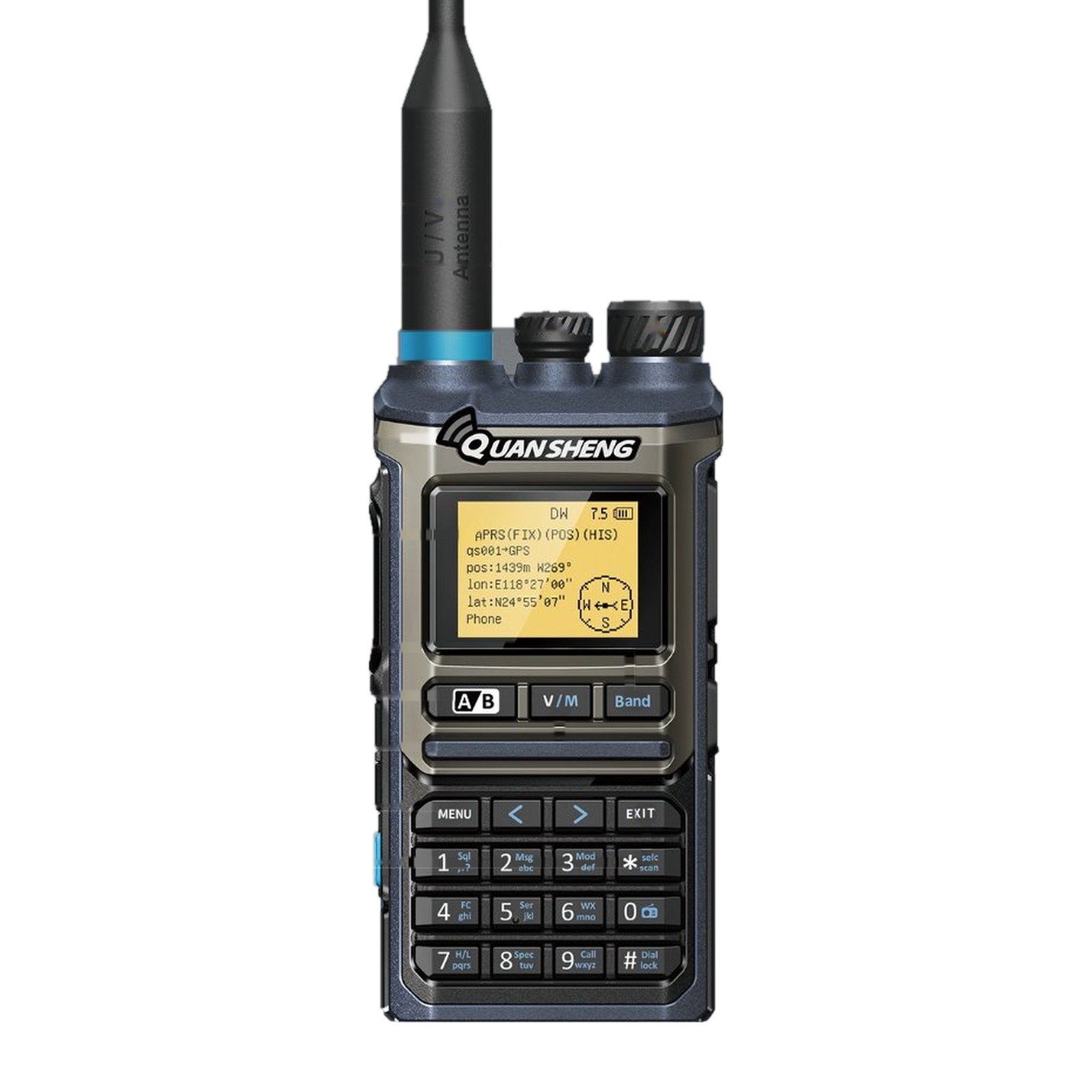
Quansheng has announced the UV-K10 Pro, a dual-band handheld that builds on the UV-K-series formula and adds APRS, optional GPS, optional medium/short-wave reception, and a claimed 10 W of output. This is not a review, as I haven’t had one on the bench, but a summary of what the manufacturer’s datasheet and announcement say about it. All figures below are Quansheng’s published numbers, and the images circulating are marked as prototype, so details may change before production units ship.
Three versions
The datasheet lists several features as “optional”, which makes it unclear what you actually get in the box. Quansheng’s announcement clarifies that there are three variants:
- Basic: the standard feature set, with no GPS/APRS and no Si4732.
- GPS: Basic plus GPS and APRS.
- Full: Basic plus GPS/APRS plus the Si4732 receiver.
So APRS and GPS come together, and the Si4732 is only on the top-tier version. If you want the Si4732 you are also buying GPS/APRS. At the time of writing I haven’t seen pricing or availability for any of the three, so check which variant a listing actually refers to before ordering.
Transmit and receive
Transmit coverage is 136–174 MHz and 350–490 MHz, so 2m and 70cm are both covered with room either side. Output is specified at up to 10 W, with high/medium/low power selection. The datasheet quotes a transmit current of 2.5A or less, stray emissions of 7.5µW or less, and adjacent channel power of 70dB (25 kHz) and 60dB (12.5 kHz). Both 12.5kHz and 25kHz channel spacing are supported. As ever, being able to transmit on a frequency doesn’t mean you’re permitted to, so stay within your licence and your national band plan.
In normal mode, receive coverage is 30–580MHz. Modes listed are FM, AM, SSB and CW. Sensitivity is quoted as -121 dBm to -123 dBm (FM, 12 dB SINAD) depending on the sub-band, with -110 dBm for wideband FM at 20 dB SINAD.
The Si4732 option
On the Full version, the Si4732 extends receive coverage down to 0.153 MHz, which takes in LW, MW and SW as well as the broadcast FM band. The radio has memory banks for these: 32 FM, 32 LW, 32 MW and 18 SW channels. A separate antenna port, labelled for 0.153–18 MHz, sits at the top of the radio, so you can connect an external HF antenna rather than relying on the rubber duck. AM sensitivity is quoted at -100 dBm (0.153–1.799 MHz) and -110 dBm (1.8–30 MHz), which is respectable for a handheld but means an external antenna will still matter on the lower bands.
APRS and GPS
On the GPS and Full versions, the radio supports APRS, with position data shown on the display, including coordinates, altitude, heading and a compass graphic. A dedicated APRS key is on the side and is customisable. Quansheng also advertises an SOS alert function and an emergency alarm.
Features worth noting
Programming options include Bluetooth, PC (via the USB-C port on the radio body) and “onsite” programming from the keypad. There are 999 channels, with channel names editable (Chinese and English are supported). Other features listed include a spectrum analyser, a frequency meter, a field strength display, CTCSS/DCS, DTMF (including ANI and selective call), 5-tone selective call, VOX, a 10-group scrambler, a 1750 Hz tone, repeater-forwarding confirmation, busy channel lock, dual-channel standby, multi-scan, and ten NOAA weather channels. Remote kill/revive is also on the list, along with a power-on password.
Hardware
The display is a 1.44-inch RGB LCD with adjustable colour and a custom power-on image. The keypad has 19 front keys, three function keys on the left side, and the PTT. The radio measures 107.9 × 54.9 × 36.7 mm without the knobs and weighs 271 g without the antenna and belt clip. Operating temperature is stated as -20 °C to +60 °C, and frequency stability is ±1 ppm.
The battery is a 7.4V, 2500mAh pack. Charging is by USB-C on either the radio body or the battery itself, or via the optional base charger. Standard accessories are the battery, adaptor, USB cable, antenna, belt clip and hand strap. Base charger, a speaker/mic and a headset are optional extras.
Things the datasheet doesn’t say
A few details are missing. There’s no stated battery life, no indication of how the high-power setting behaves under sustained transmit, and no detail on APRS capabilities such as digipeating or smart beaconing. The audio output is quoted at 0.5W or more, with distortion of 10% or less, which tells us little about real-world speaker quality. I’d want to see independent measurements of transmit power across the band, harmonic suppression at 10W, and receiver performance in the presence of strong signals before drawing conclusions.
On paper, the UV-K10 Pro looks like a feature-rich handheld, particularly for people who want APRS or wideband listening in one unit. Whether it delivers will depend on production units, and I’ll update this post when independent test results appear.
Gallery
Video
Features
APRS / Bluetooth / CTCSS / DCS / DTMF / Dual VFO / Frequency Copy / GPS / Scan / Speaker / Split Operation / Timeout Timer / USB Charging / VOX
Transmitter
| Maximum RF output (watts): | 10 |
|---|
Power
| Battery voltage: | 7.4 |
|---|---|
| Battery capacity (mAh): | 2500 |
Physical
| Width (mm): | 54.9 |
|---|---|
| Height (mm): | 107.9 |
| Depth (mm): | 36.7 |
| Weight (g): | 271 |
| Connectors: | SMA, Microphone, Speaker Out, USB Port |
Meta
| Year of release: | 2026 |
|---|---|
| Related radios: | Quansheng UV-K5, Quansheng Taiko Kong TK11, Quansheng UV-K1 Mini Kong, |
Buy
- No link available just yet.