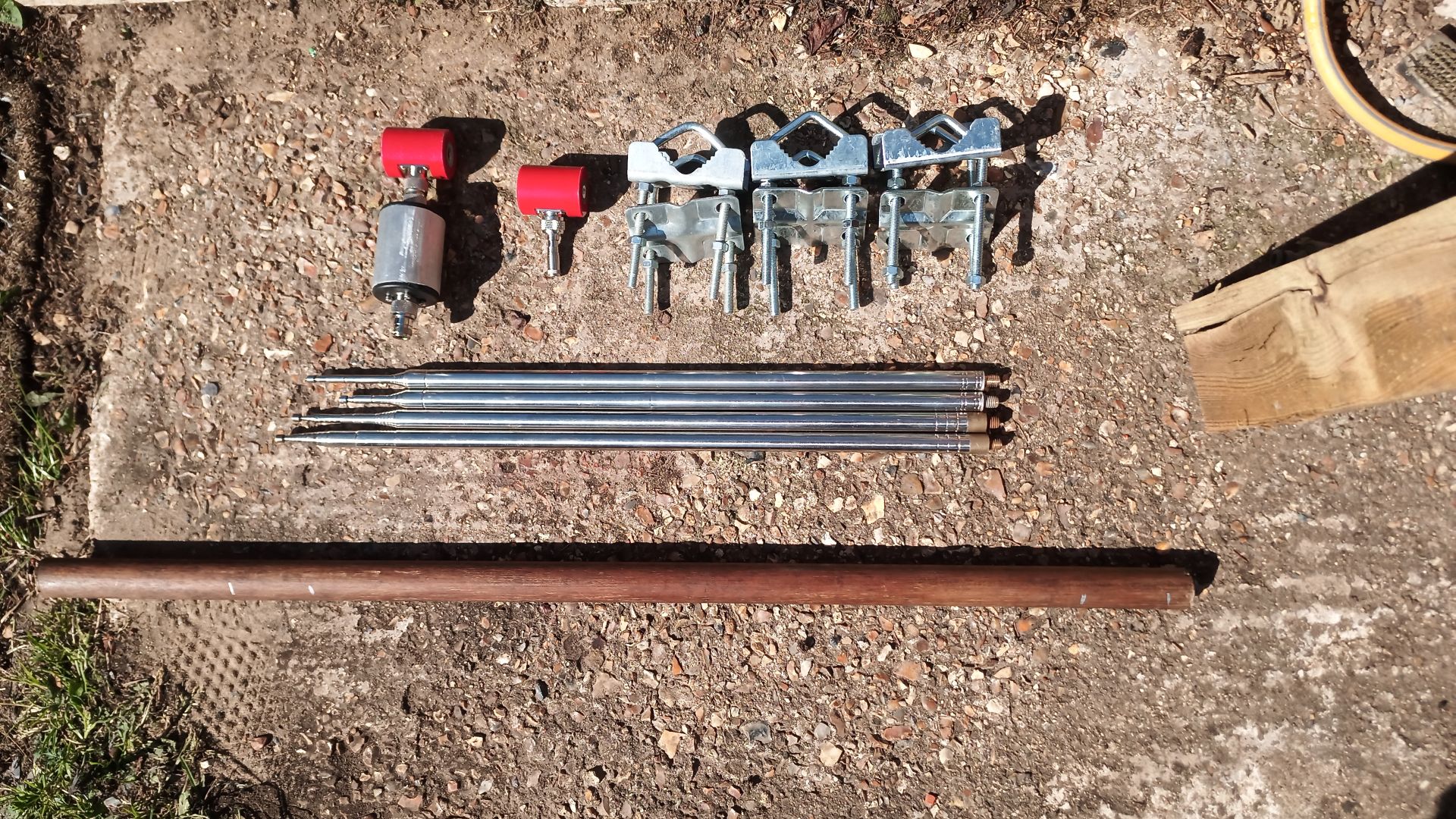
I’ve had a lot of success using the common 5.6m telescopic stainless steel whips – as a quarter wave vertical, as a dipole, and even as a full wave loop. As I had a few of them kicking around, I figured why not try and use them to make a 2 element yagi-uda that fits in a backpack.
Overview
I’m making a point of calling this a yagi-uda, as the story goes that this antenna was developed by a Mr Yagi and a Mr Uda, and Mr Uda is often forgotten! My example here is for the 6m band, just because I have a really small garden, and it’s the start of the sporadic E season, but this same setup will work for 20m, 17m, 15m, 12m, 10m, and 6m. Your choice of band will affect the length of boom that you need. I used an old tool handle just because it was what I had laying around, but almost anything 1-2″ in diameter will do – wood, metal, even PVC pipe if it’s thick enough.
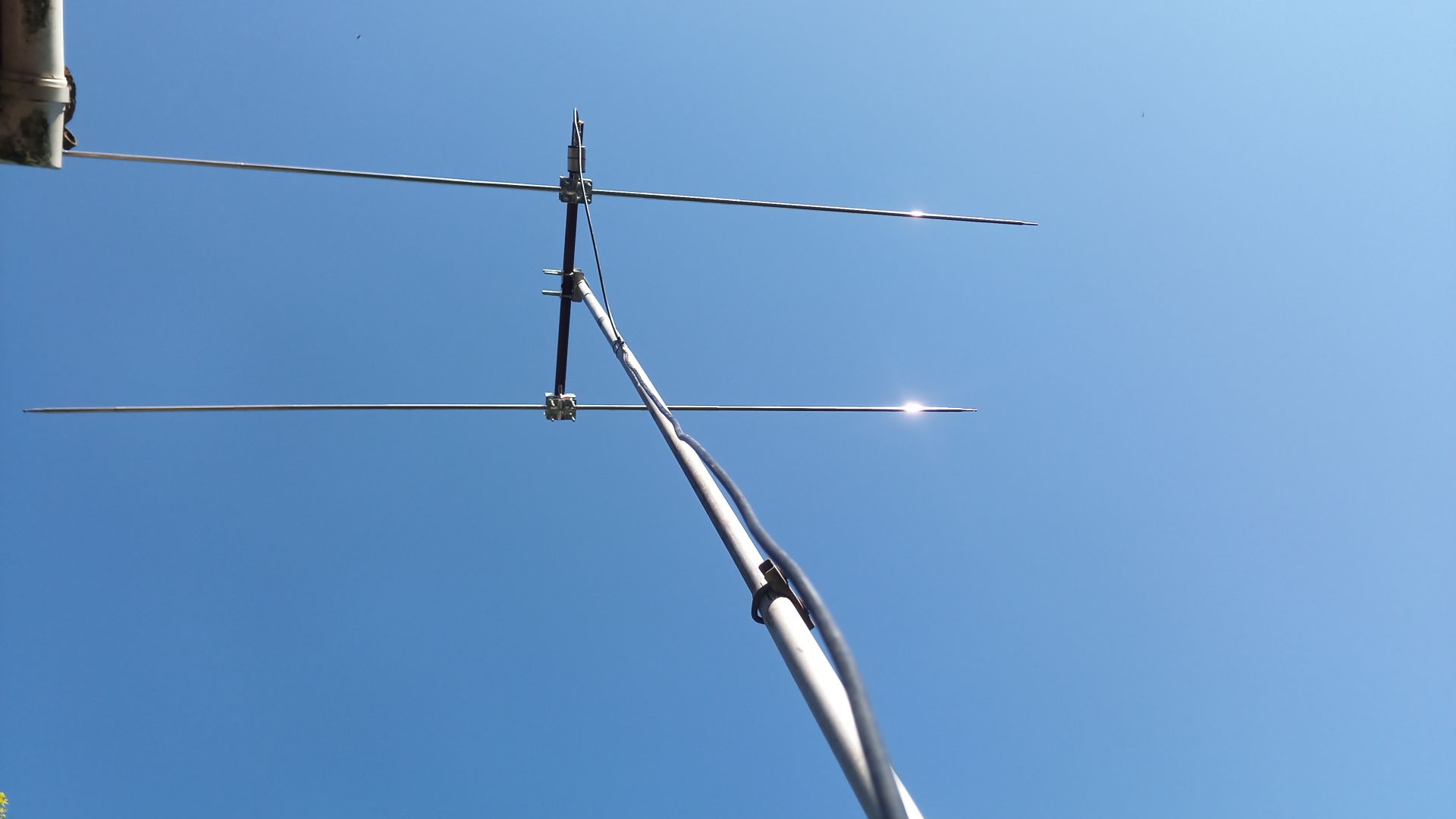
I opted for using a driven element and a director, rather than a reflector. I used this calculator to work out the lengths of the elements, but then ended up extending them a little because I mostly work digital modes towards the bottom of the band. Don’t treat the numbers too literally, just use them as a guide.
Parts
- BD7IBI 5.6m stainless steel telescopic whip x 4
- “Red barrel” feedpoint adapter x 2 (you only really need 1)
- Something to use as a boom
- “Shelly clamp” x 3
- 1:1 Choke balun (optional, but recommended)
- Shorted PL259 plug (only needed if you are using 2 red barrels)
- 10mm to 10mm adapter (only needed if you’re using a single red barrel)
Assembly
- Attach the Shelly clamps to the boom. Fix one, and then attach the 2nd one loosely (at the correct spacing), place the boom on the ground onto the threads of the clamps. This makes sure that both clamps are in exactly the same plane, and not twisted. Tighten up the 2nd clamp.
- Attach the feedpoint(s) to the Shelly clamps. These are the perfect size to fit inbetween the threads of the clamps, so you don’t need to take the clamps completely apart.
- Balance the boom on your finger to find and mark the center of balance. If you are using a choke, this will be slightly towards the back of the boom.
- Attach the whips to the red barrels. If you’re using 2 of these, add the shorted PL259 to the director.
- Measure and extend the whips to the correct length for your band of choice. Use the thickest part of the whips for both strength, and improved bandwidth.
- Attach a Shelly clamp to your mast.
- Attach the boom to the clamp on the mast. It may be easier to do this step earlier if you have a push-up mast, as you can assemble the antenna directly on the mast.
- Attach your coax and zip tie it to the mast for strain relief.
- Raise the antenna and check the SWR.
Cost
- The whips are from Ali Express and you can find packs of 2 for around £25
- Red barrels are around £5 each
- Shelly clamps around £5 each
- Boom ??? (depends on what you have to hand)
That brings the total to around £45 but the components can be used for all sorts of other things too. You can get a whip, barrel, ground spike, and some radials in a kit for around £30 which is another good option.
Notes
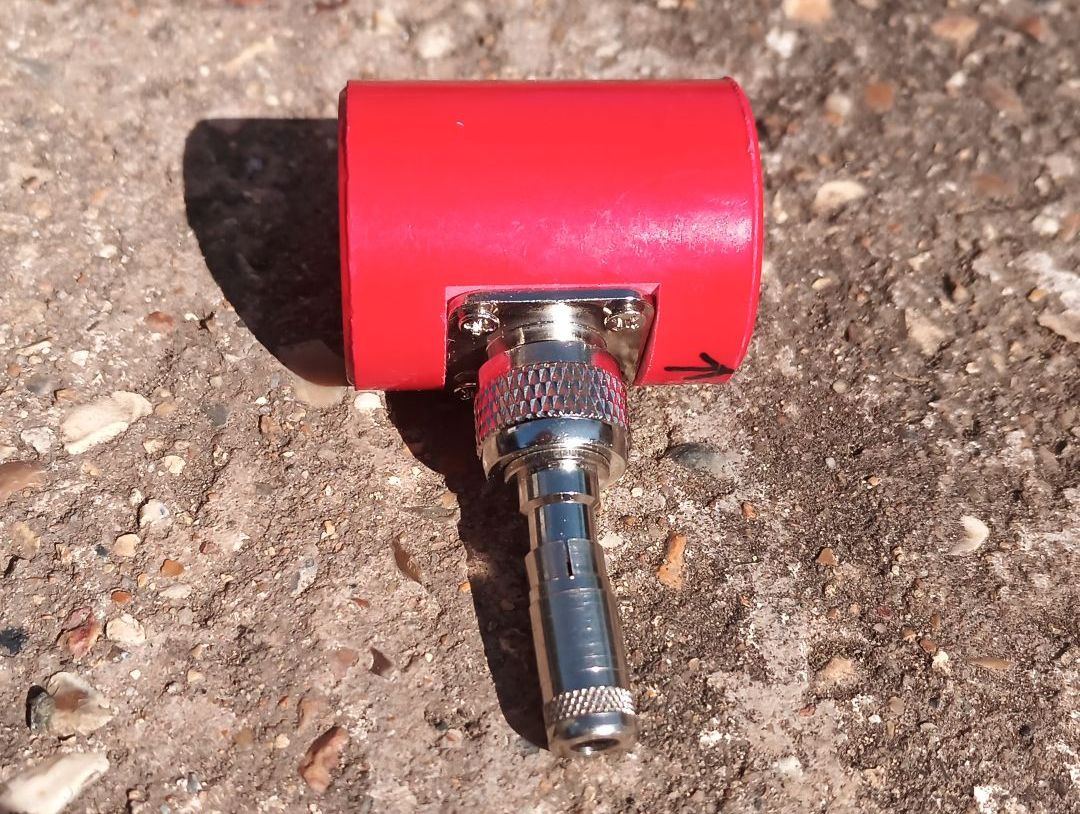
My decision to use two of the “red barrels” was simply to aid construction as they fit really nicely into the clamps. If you do this, you need to short out the SO239 so that the 2 whips are directly connected to each other. Alternatively, just use a long 10mm nut to connect the whips back-to-back, but you’ll need to figure out your own method of mounting this onto the boom.
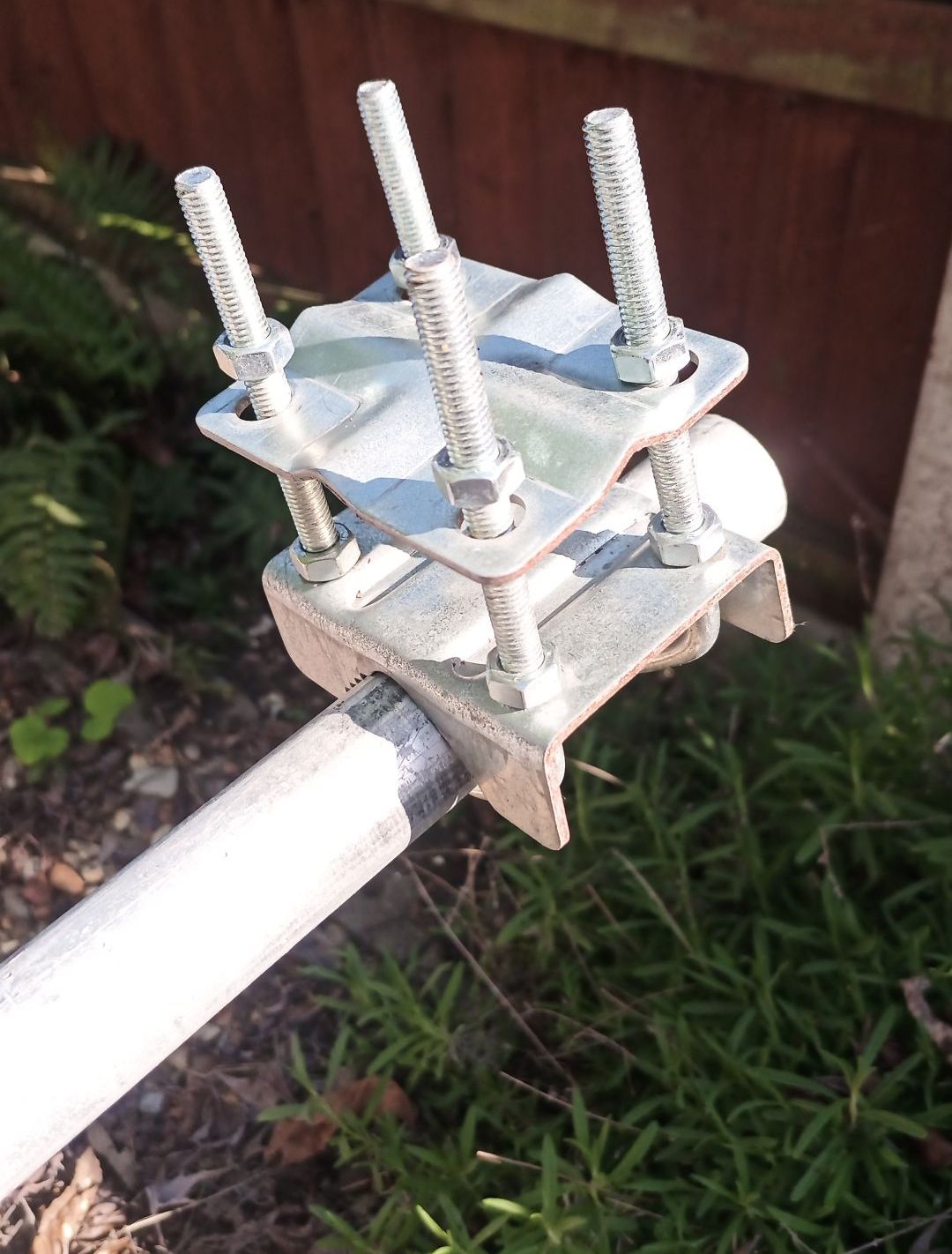
These clamps are known as “Shelly clamps” in the UK, but may be known as something different where you are. They are for clamping two poles in a perpendicular fashion and the red barrels fit really well in them. No need to clamp them up “gorilla tight”, you’ll only damage the barrel or your mast!
You can of course opt for a driven element and a reflector, rather than a driven element and a director. More info about that, and about element spacing can be found in this article by WB2VUO.
I’ve yet to use the antenna in anger as there’s not a lot of Es around just yet, but you should expect somewhere around 3dB of gain over a dipole (despite many sources saying you will get more).