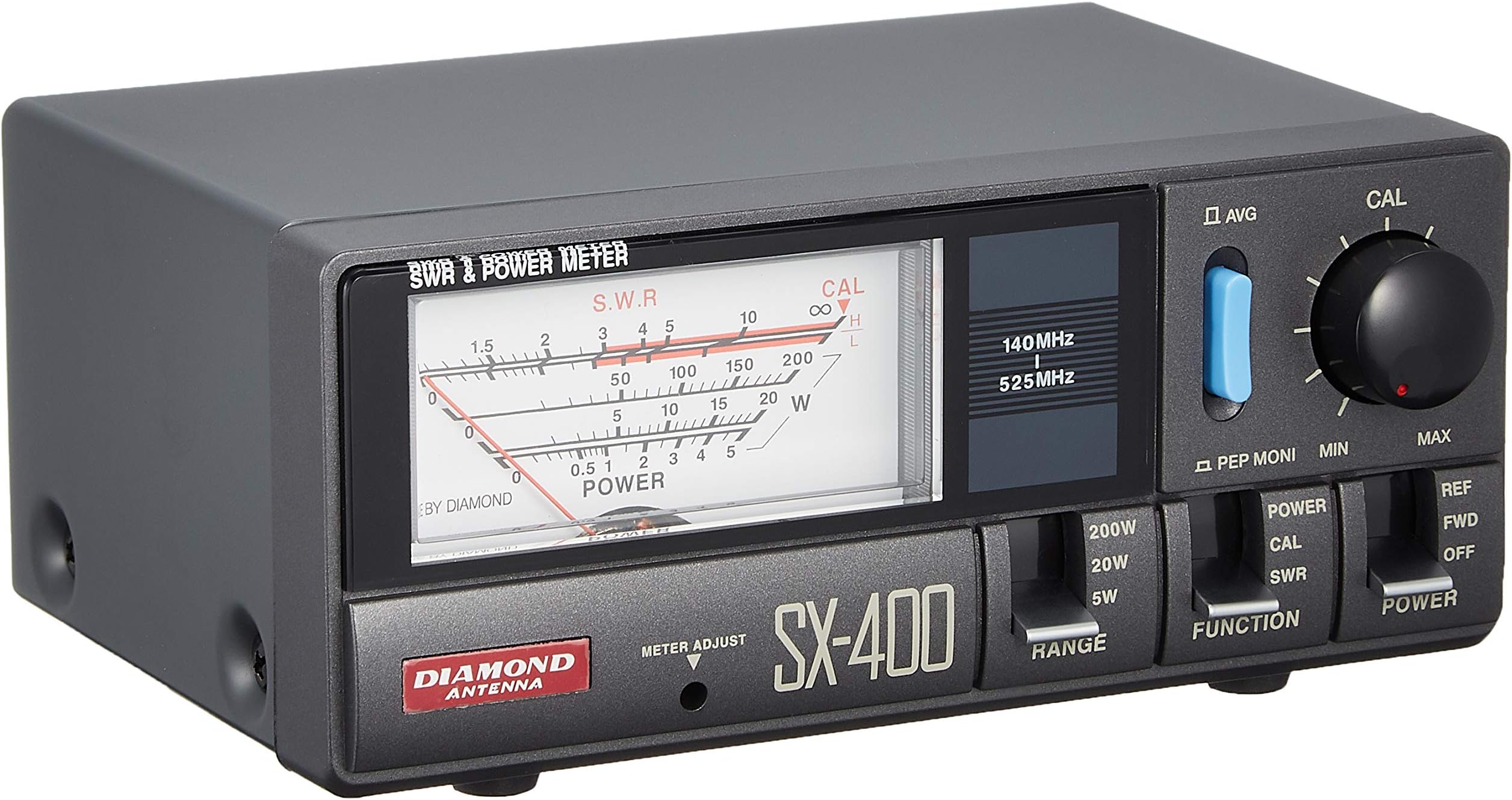
Ask almost any new amateur radio operator what they’re aiming for when they put up an antenna, and you’ll almost certainly hear the same answer: “A 1:1 SWR.” It gets repeated on forums, in club meetings, and in YouTube comments with the confidence of gospel truth. There’s just one problem – for the vast majority of antennas, a 1:1 SWR is not only unnecessary, it’s actually a sign that something might be wrong.
Let’s unpack this myth properly.
What Is SWR, and How Is It Calculated?
SWR – Standing Wave Ratio – is a measure of how well the impedance of your antenna system matches the impedance of your feedline. Most modern transceivers and coaxial feedlines are designed around a 50-ohm characteristic impedance. When your antenna’s feedpoint impedance is also 50 ohms, the match is perfect: 1:1. Energy flows from the rig to the antenna without any reflection. Great, right?
Well, yes – but only if your antenna actually presents 50 ohms at its feedpoint. And here’s the thing: most textbook antennas simply don’t.
The formula is as follows:
SWR = R / Z₀ (when R > Z₀), or SWR = Z₀ / R (when Z₀ > R)
Where R is the resistive feedpoint impedance of the antenna (assuming a purely resistive impedance — no reactance) and Z₀ is your feedline’s characteristic impedance (50 ohms).
Let’s apply that to a couple of classic antennas:
The half-wave dipole has a theoretical feedpoint impedance of approximately 72 ohms in free space. Plug that in:
72 ÷ 50 = 1.44:1
So a perfectly constructed, perfectly resonant half-wave dipole – the most fundamental antenna in amateur radio – should show around 1.44:1 SWR, not 1:1. If yours is showing 1:1, something else is going on.
The quarter-wave vertical over a ground plane has a feedpoint impedance of approximately 36 ohms:
50 ÷ 36 = 1.39:1
Again, not 1:1. A quarter-wave vertical reading 1:1 is not “more perfect” than one reading 1.4:1 – it may actually indicate that ground or environmental losses are eating up some of your signal (more on that shortly).
So When Should You See 1:1?
There are a handful of antenna designs that genuinely do target 50-ohm feedpoint impedance. One of the best examples is a quarter-wave ground plane with elevated radials. By angling the radials downward at roughly 45°, the feedpoint impedance rises from the ~36 ohms of a flat ground plane to close to 50 ohms – giving a natural 1:1 match without any matching network. That’s a case where 1:1 is expected and correct.
Other examples include certain folded dipoles with specific conductor diameter ratios, J-poles designed for 50-ohm feed, and antennas that incorporate deliberate impedance transformation into their physical structure.
These are the exceptions, not the rule. Most wire antennas, verticals, and beams will show an SWR somewhere between 1.4:1 and perhaps 2:1 when working correctly.
The Dummy Load: A Perfect 1:1 Match on Every Band
Here’s the thought experiment that makes the point most dramatically: a dummy load – a non-inductive 50-ohm resistor designed to absorb RF – will give you a flawless 1:1 SWR on every single band. Every frequency. Perfect match. Your SWR meter will be ecstatic.
It will also be a completely useless antenna. Every watt you put in will be converted directly to heat, and not a single milliwatt will be radiated into the ether.
This is the core lesson: SWR is a measure of impedance match, not antenna efficiency, gain, or radiation. A 1:1 SWR tells you that your transmitter sees the impedance it expects. It says nothing about whether your antenna is actually doing its job of getting your signal out.
The Feedline Loss Trap
This one catches a lot of operators out, and it’s a counterintuitive one.
Suppose you put up an antenna that reads 1.5:1 SWR on your meter. You decide to replace your ageing, lossy coax with a new, low-loss feedline. Same antenna. Same everything else.
After the upgrade, you’re dismayed to find that your SWR has gone up — perhaps to 2.0:1 or even 2.5:1. What went wrong?
Nothing. In fact, things got better.
Lossy feedline masks true SWR. The signal bouncing back from a mismatched antenna gets attenuated on its return trip through the lossy coax, so your meter – which is measuring at the transmitter end of the feedline – sees less reflected power than is actually present at the antenna. High feeder loss makes a bad antenna look better than it is.
When you replace that lossy coax with quality low-loss cable, the reflected signal arrives back at your meter with less attenuation, and the true mismatch becomes visible. The antenna hasn’t changed at all – you’re just getting an honest reading for the first time.
The practical implication: if you improve your feedline and your SWR reading goes up slightly, don’t panic. You haven’t broken anything. You’ve just removed a hidden measurement error.
“But My Radio Won’t Like It!”
Modern transceivers typically start folding back power above about 2:1 or 3:1 SWR – a protection measure to prevent damage to the PA stage. This is a valid engineering constraint, but it’s a property of the radio, not evidence that the antenna is bad.
The usual solution is an antenna tuner (ATU) – either built into the radio or as a separate unit. A tuner doesn’t improve the actual match at the antenna; it transforms the impedance seen at the tuner input to 50 ohms, making the radio happy. The mismatch still exists on the feedline between the tuner and antenna, but provided the feedline losses are acceptable at that SWR, the system works perfectly well.
There’s nothing wrong with using a tuner. The goal is to get RF into the air efficiently, and a tuner is a legitimate tool for doing exactly that.
What Should You Actually Aim For?
Rather than chasing 1:1 as a magic number, here’s a more useful framework:
1. Understand your antenna’s expected feedpoint impedance before you build or buy it. Know what SWR figure represents a healthy, correctly working antenna.
2. Aim for resonance (minimal reactance at your target frequency) – this is more meaningful than the raw SWR figure.
3. A practical SWR below about 2:1 at the antenna feedpoint is generally excellent. Many fine antennas operate comfortably at 2:1 or even slightly beyond, especially with a tuner.
4. Use low-loss feedline and accept that it may reveal a higher (but more honest) SWR reading than cheap coax did.
5. Don’t confuse a good SWR with a good antenna. Evaluate your antenna by what actually matters: how well you’re making contacts, your received signal reports, and comparison against a known reference.
The Bottom Line
The 1:1 SWR myth persists because it sounds clean, simple, and definitive – exactly the kind of target beginners gravitate toward. But chasing 1:1 without understanding what it means can lead you to make your antenna worse in pursuit of a number that was never the right goal in the first place.
A well-designed antenna that measures 1.5:1 or even 2:1 is almost certainly outperforming a compromised antenna that’s been “tweaked” to show 1:1 on the meter. The ionosphere doesn’t care about your SWR. It cares about your radiated signal.